
CHANCE® Helical Piers
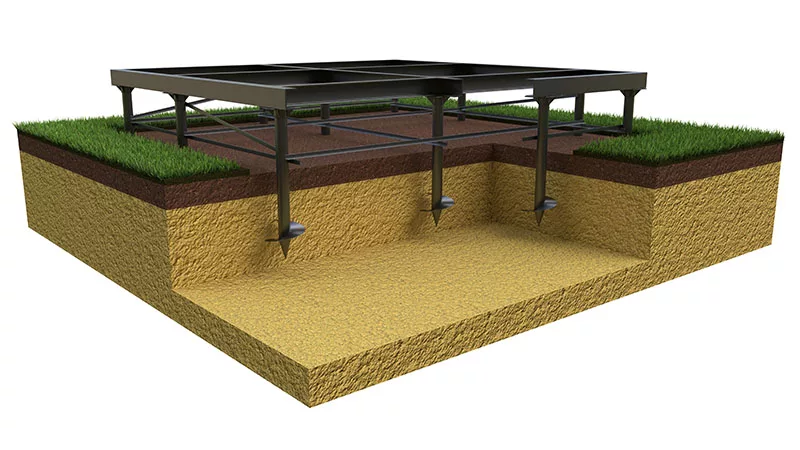
Steel helix plates torqued down past the moving clay into stable soil. Capacity is verified on every pier, and they carry load immediately.
Learn about CHANCE® Helical Piers
Family-owned · Oklahoma City · Est. 1982
Oklahoma's clay soil never stops moving. We anchor your home below it with CHANCE® helical piers and Atlas Resistance® piers — a permanent fix, not a patch.
Tell us what you're seeing. We'll call you back within 1 business day.
“Price is Important but not as Important as Quality, Value and our Reputation”
Warning signs
Foundation trouble rarely shows up all at once. If you're noticing any of these around your home, it's worth a free look.
Sections of the floor or patio dropping below the rest.
Visible cracks in the slab, stem wall, or beam.
Stair-step cracks or gaps around windows and corners.
Diagonal cracks running from door and window corners.
Doors that rub, won't latch, or windows that bind.
Floors that feel uneven or a ball that rolls on its own.
Our systems
Steel helix plates torqued down past the moving clay into stable soil. Capacity is verified on every pier, and they carry load immediately.
Learn about CHANCE® Helical Piers

Steel piers hydraulically driven to load-bearing strata using your home's own weight — then the structure is lifted and stabilized.
Learn about Atlas Resistance® Piers
Why Oklahoma foundations move
Central Oklahoma sits on highly plastic, expansive clay. A wet spring makes it swell; a dry August makes it shrink and pull away. Add the area's increased seismic activity and you get foundations that heave, settle, and crack.
Read about Oklahoma foundation problemsWhy choose Atlas
We tell you what your foundation actually needs — and when it doesn't need anything.
Every pier is measured as it's installed, so support isn't a guess.
We've worked on this clay since 1982. We know how it behaves.
Licensed, insured, and warranties on our pier work.
Service area
Based in Oklahoma City, we serve homeowners, builders, and engineers across the state.
FAQ
In most cases, yes. Our red clay swells when it's wet and shrinks when it's dry, and that movement happens in the upper layers of soil. Helical piers are screwed down through that active zone into firmer, stable soil below, so your home stops riding the clay up and down.
Yes. Drought shrinks the clay and lets part of a foundation drop. By transferring the weight to piers that bear on stable soil or rock beneath the dry zone, we can stabilize the foundation and, in many cases, lift it back toward its original position.
Absolutely. Builders and engineers use them for slabs, home additions, porches and decks, garages, columns, and retaining walls. They carry load the moment they're installed, so there's no waiting on concrete to cure.
With helical piers, we monitor installation torque on every pier — torque correlates directly to load capacity, so each one is confirmed as it goes in. With Atlas Resistance® Piers, each pier is driven to refusal and the hydraulic pressure is recorded, giving a measured support value for every location.
Free inspection and a straight answer — even if the answer is that you don't need us.